

Price: $1,399.99
(as of 2026-10-15 13:13 GMT+0000 – Details)

Processing Architecture and System AI Capabilities
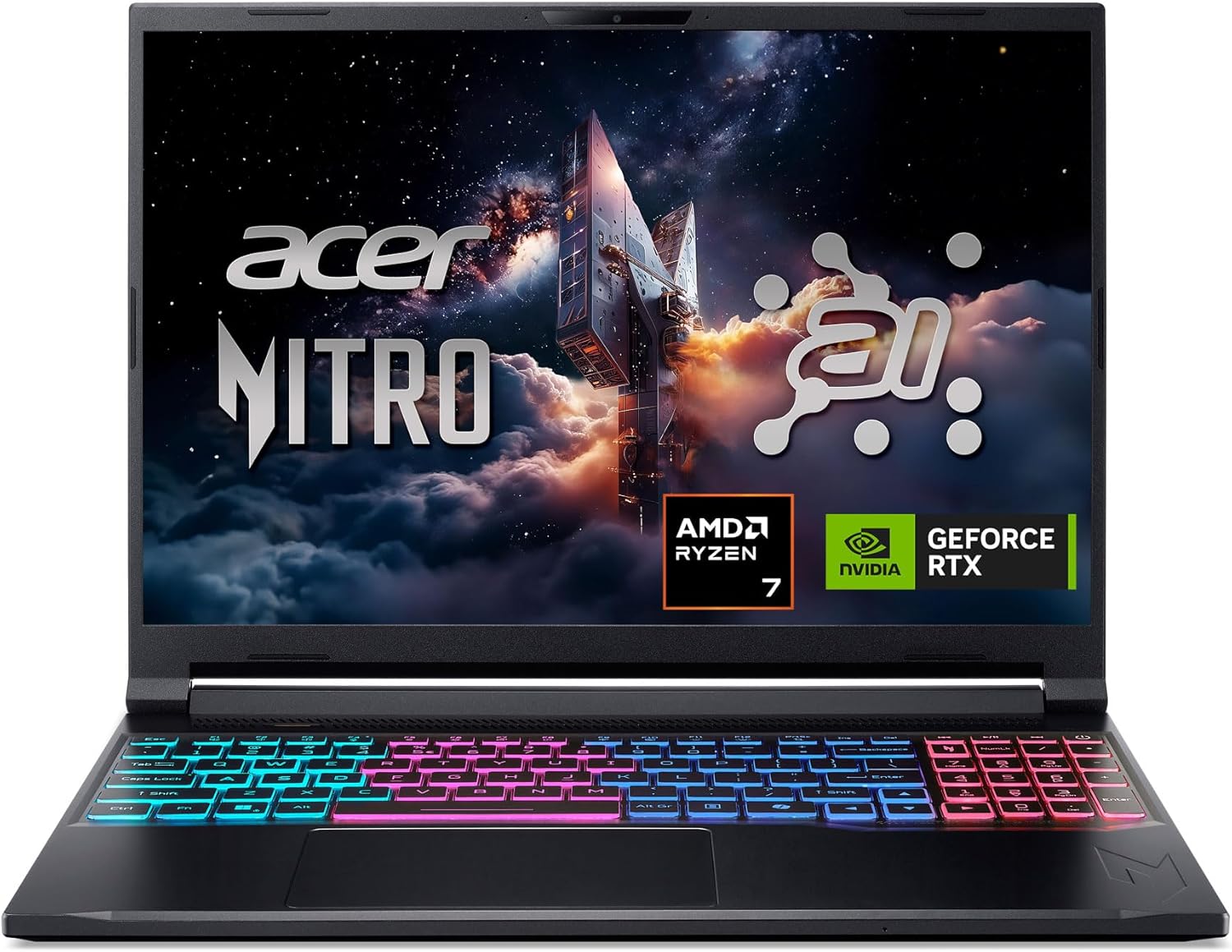
The Acer Nitro V 16S AI Gaming Laptop (model ANV16S-41-R2AJ, part number NH.QZYAA.001) is engineered to address demanding computing environments through specialized processing hardware. Central to the device is the AMD Ryzen 7 260 processor, a central processing unit designed to execute complex computational tasks. This processor delivers up to 38 AI Overall TOPS (trillion operations per second), providing dedicated hardware acceleration for local artificial intelligence functions and contemporary gaming workloads. Beyond traditional gaming, the CPU architecture is built to handle high-resolution 4K HDR streaming, accommodating users who combine gameplay with live broadcasting or media playback. By handling background system logic and computational tasks, the Ryzen 7 260 maintains responsive operation during multi-threaded productivity and entertainment sessions.
A defining characteristic of this laptop is its dual-source artificial intelligence framework, which integrates the CPU’s compute capabilities with substantial graphical AI performance. While the AMD Ryzen 7 260 provides 38 AI TOPS for central processing tasks, the system’s graphics hardware contributes an additional 572 AI TOPS of computational horsepower. In practical terms, this distribution of AI horsepower ensures that system-level machine learning functions and graphics-centric neural processing operate on dedicated silicon paths without competing for the same resources. This multi-tiered processing design provides the bandwidth necessary to support modern AI-driven software, creative productivity tools, and computational rendering tasks concurrently on a mobile platform.
Graphics Fidelity, Blackwell Architecture, and DLSS 4
Dedicated graphical rendering is powered by the NVIDIA GeForce RTX 5060 Laptop GPU, which is constructed on NVIDIA’s Blackwell architecture. This GPU brings cinematic graphics fidelity and full ray tracing into mobile form factors, accurately simulating the physical behavior of light, reflections, and ambient shadows. Graphical computation is accelerated by fourth-generation RT Cores that handle path tracing and complex lighting interactions at unprecedented speeds. Operating alongside the ray tracing hardware, fifth-generation Tensor Cores manage deep learning and neural rendering workloads. The resulting 572 AI TOPS of graphics horsepower allows the RTX 5060 to drive intensive gaming titles and graphical computations while maintaining structural visual detail.
To maximize frame rates and preserve image clarity, the graphics subsystem leverages DLSS 4, NVIDIA’s proprietary suite of neural rendering technologies. Driven by the fifth-generation Tensor Cores found on the RTX 50 Series GPU, DLSS 4 introduces Multi Frame Generation in tandem with enhanced Ray Reconstruction and Super Resolution. Rather than computing every pixel through traditional rendering pipelines, the system utilizes AI models to predict and construct intermediate frames, refine ray-traced surfaces, and upscale lower-resolution inputs. This workflow boosts frames per second (FPS), diminishes input latency, and enhances overall visual sharpness, allowing fast-paced action sequences to remain fluid without degrading fine visual textures.
Visual Experience and Display Engineering
Visual output is delivered via a 16-inch WUXGA display operating at a native resolution of 1920 x 1200. Featuring IPS (in-plane switching) technology, the screen offers wide viewing angles and consistent image presentation across the entire panel. For fast-paced gaming, the panel incorporates a high 180Hz refresh rate, which reduces visual tearing and motion blur during rapid in-game movements. Alongside its gaming responsiveness, the display achieves 100% sRGB color coverage, ensuring precise and true-to-life color rendering. This color accuracy makes the screen equally suited for content creation, allowing designers, video editors, and gamers to view visual assets exactly as intended.
Memory, Storage, and Hardware Expansion Limits
The internal hardware arrangement provides high-speed memory and solid-state storage with distinct upgrade parameters. System multitasking is supported by 32GB of DDR5 5600MHz memory configured across two physical slots. A crucial specification to note is that 32GB represents the maximum supported memory capacity of the laptop; because both slots are populated, the RAM configuration cannot be expanded further. Storage is handled by a 1TB PCIe Gen 4 SSD, delivering rapid data access and short loading intervals. Unlike the memory, storage capacity retains upgrade potential through two PCIe M.2 slots, with one slot left open and available for future secondary drive installation.
Chassis Design, Thermal Regulation, and Wireless Connectivity
Rounding out the laptop’s construction is a slim, portable chassis designed specifically for gaming and productivity on the move. Despite housing high-power components like the Ryzen 7 260 and RTX 5060, the sleek profile maintains portability for everyday carry. Thermal regulation within this compact form factor is managed by a specialized quad-intake cooling system, designed to draw in sufficient ambient air to keep critical silicon cool under prolonged operating loads. For networking, the system integrates Wi-Fi 6 wireless technology, ensuring fast, stable data transmission required for competitive online multiplayer, large game file downloads, and smooth 4K HDR streaming without physical Ethernet dependencies.