



Price: $1,799.99
(as of 2026-10-15 21:18 GMT+0000 – Details)

Processor Architecture and Clock Performance
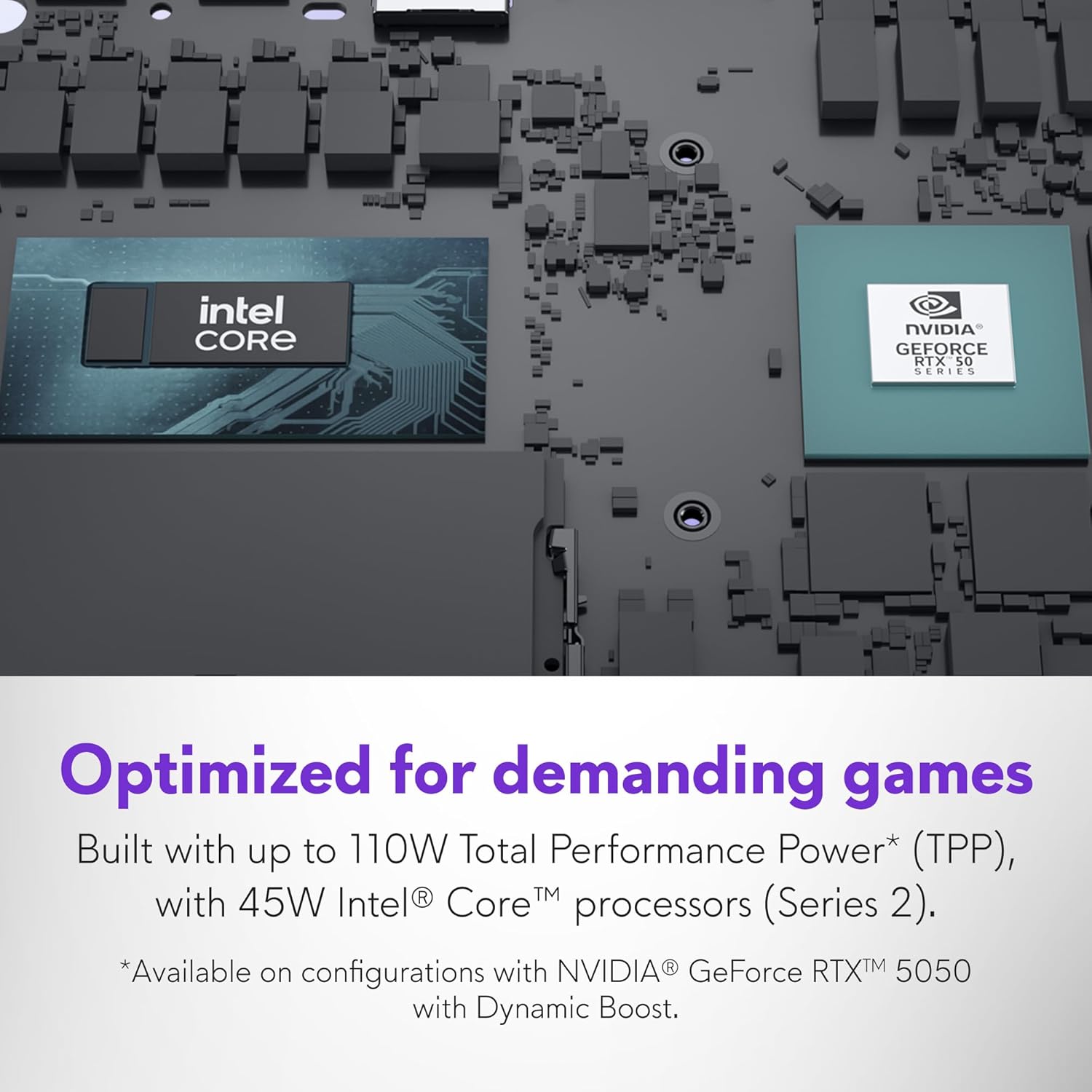
The system is built around an Intel Core 7 240H 10‑core processor that combines six performance cores with four efficient cores, delivering 16 threads for parallel task handling. The part is specified to reach up to 5.2 GHz with Intel Turbo Boost Technology and includes a 24 MB Intel Smart cache. This configuration aims to provide high single‑threaded speed for latency‑sensitive applications such as gaming, while the core count supports multitasking across productivity workloads. Practical considerations include reliance on software optimization to exploit the core‑mix efficiently; older or single‑threaded programs may not fully utilize the efficient‑core segment. The advertised clock ceiling suggests headroom for demanding workloads, but actual sustained performance will depend on thermal design and power delivery outside the scope of the supplied specifications.
Graphics Subsystem and Visual Fidelity
An NVIDIA GeForce RTX 5050 with 8 GB of GDDR7 memory powers the graphics pipeline, a component positioned to elevate gameplay to new heights and immerse users in lifelike visuals. The description associates the subsystem with the ability to dominate every challenge, indicating a focus on high‑frame‑rate rendering and detailed scene rendering for modern titles. From a practical standpoint, the GDDR7 memory pool supports high bandwidth for texture and frame buffering, which can reduce stuttering in bandwidth‑intensive scenarios. However, the actual visual fidelity achieved will hinge on game engine compatibility, driver support, and the resolution/refresh‑rate settings of the attached display. No specific features such as ray‑tracing cores or DLSS versions are detailed in the provided text, so claims beyond the stated “lifelike visuals” cannot be substantiated.
Memory Capacity and Storage Throughput
The laptop ships with 32 GB of DDR5 memory operating at 5600 MHz, paired with a 1 TB PCI‑E NVMe M.2 solid‑state drive. The memory volume is marketed as enabling blazing‑fast load times for games and applications, while the SSD promises rapid data access for library loading and system boot sequences. Practically, such a large DDR5 pool supports smooth multitasking—running several browser tabs, background patches, and a game simultaneously—provided the operating system and software can address the high‑density memory space. The 1 TB capacity offers substantial room for installers, media collections, and save files, though the effective throughput will be constrained by the NVMe interface version and controller efficiency, details not specified in the description. No assertions about endurance ratings or write‑cycle limits are made.
Display Specifications and Viewing Experience
A 16‑inch WQXGA panel with a native resolution of 2560 × 1600 forms the visual canvas, complemented by a 300‑nit anti‑glare coating, 100 % sRGB color gamut, ComfortView Plus technology, and a 120 Hz refresh rate within a thin bezel LCD design. The stated specifications aim to deliver crystal‑clear imagery and a smooth gaming experience, with the high refresh rate intended to minimize motion blur during fast‑paced sequences. The anti‑glare treatment and color gamut target accurate content representation for both creative work and entertainment. From a practical angle, the 120 Hz rate requires source content—such as games or media encoded at matching frame rates—to fully realize its benefit; lower‑frame material will be displayed at the panel’s maximum without interpolation artifacts introduced by the panel itself. Exact color‑accuracy calibration and viewing angles are not quantified beyond the supplied claims.
Network Connectivity and Interface Portfolio
The system integrates MediaTek Wi‑Fi 7 (2×2) and Bluetooth 5.3, positioning it for next‑generation wireless performance and low‑latency peripheral connections. Wi‑Fi 7 promises higher throughput and capacity in dense network environments, while Bluetooth 5.3 offers improved power efficiency and faster data transfers for compatible devices. A suite of physical ports expands wired options: two USB 3.2 Gen 2 Type‑C ports supporting power delivery and DisplayPort at 10 Gbps speeds, two USB 3.2 Gen 1 Type‑A ports rated at 5 Gbps, a single RJ‑45 Ethernet jack, and an HDMI 2.1 output for external monitor attachment. A combined headphone‑microphone jack rounds out audio I/O. Practically, the wireless standards aim to reduce cable clutter and enable high‑speed streaming or cloud‑gaming sessions, contingent on router and accessory compatibility. The variety of USB‑C and Type‑A ports accommodates a broad range of peripherals, though users must verify cable specifications to achieve advertised bandwidths.
Input Devices, Camera, and Operating Environment
A backlit keyboard enhances typing accuracy in dim conditions, while an integrated 720p HD camera supports video conferencing and streaming tasks. The notebook ships with Windows 11 Pro pre‑installed, providing a familiar platform for software compatibility and security features offered by that edition. The 720p camera delivers a baseline resolution for remote meetings, though lighting conditions and application software will heavily influence perceived image quality. Windows 11 Pro underpins driver support for the featured hardware components, including the Wi‑Fi 7 adapter and RTX 5050 graphics, though specific configuration steps fall outside the supplied description. The backlit keyboard layout and key travel are not detailed beyond the illumination feature, so tactile feedback and ergonomics remain unspecified.